
 Quantum Spintronics
 Research topics
Antiferromagnetic spintroncis
 For a long time, there have been no efficient ways of controlling antiferromagnets. Quite a strong magnetic field was required to manipulate the magnetic moments because of a high molecular field and a small magnetic susceptibility. It was also difficult to detect the orientation of the magnetic moments since the net magnetic moment is effectively zero. Nevertheless, the microscopic magnetic moments should in principle exhibit a similar spintronic effect as seen in ferromagnets. Recent vigorous research effort has demonstrated various interesting spintronic phenomena with antiferromagnets some of which indeed could not be found in ferromagnets. We have investigated and quantified spin current interactions in various antiferromagnets [1-3], demonstrated antiferromagnetic memory devices [4,5], and explored antiferromagnetic domains by XMLD-PEEM. These results are proving that antiferromagnets, previously considered useless, are actually useful materials in spintronics. Now, antiferromagnetic spintronics [6] is recognized as one of the exciting research subfields in spintronics.
[1] T. Moriyama et al., Phys. Rev. Lett. 119, 267204 (2017).[2] T. Moriyama et al., Phys. Rev. Appl. 11, 011001 (2019).[3] H. Masuda et al., Commun. Mater. 1, 75 (2020). [4] T. Moriyama et al., Sci. Rep. 8, 14167 (2018). [5] T. Moriyama et al., Phys. Rev. Lett. 121, 167202 (2018). [6] V. Baltz, T. Moriyama et al., Rev. Mod. Phys. 90, 015005 (2018); T. Jungwirth et al., Nat. Nanotechnol. 11, 231 (2016).
THz spintroncis
 In antiferromagnetic spintronics where manipulation of the antiferromagnetic spins is a central technological challenge, it is important to understand the dynamic properties, especially their THz spin dynamics and the magnetic damping [1]. While both experimental and theoretical investigations of the antiferromagnetic resonance began in 1950s, they have been recently revisited with more advanced experimental techniques as well as with more rigorous theoretical treatments. We have recently reported series of experimental results regarding THz dynamic properties of antiferromagnetic materials focusing on the relaxation dynamics. We have explored frequency-domain THz spectroscopies of antiferromagnetic NiO and detail quantitative analysis of the antiferromagnetic damping [2], control of the antiferromagnetic resonance properties by various cation substations [3], and observation of the THz spin pumping effect [4], and. These results are important milestone for future THz antiferromagnetic spintronics.
[1] T. Moriyama et al., J. Phys. Condens. Matter 33, 413001 (2021). [2] T. Moriyama et al., Phys. Rev. Mater. 3, 051402 (2019). [3] K. Hayashi, T. Moriyama et al., Appl. Phyis. Lett. 119, 032408 (2021). [4] T. Moriyama et al., Phys. Rev. B 101, 060402 (2020).
Photo-spintronics
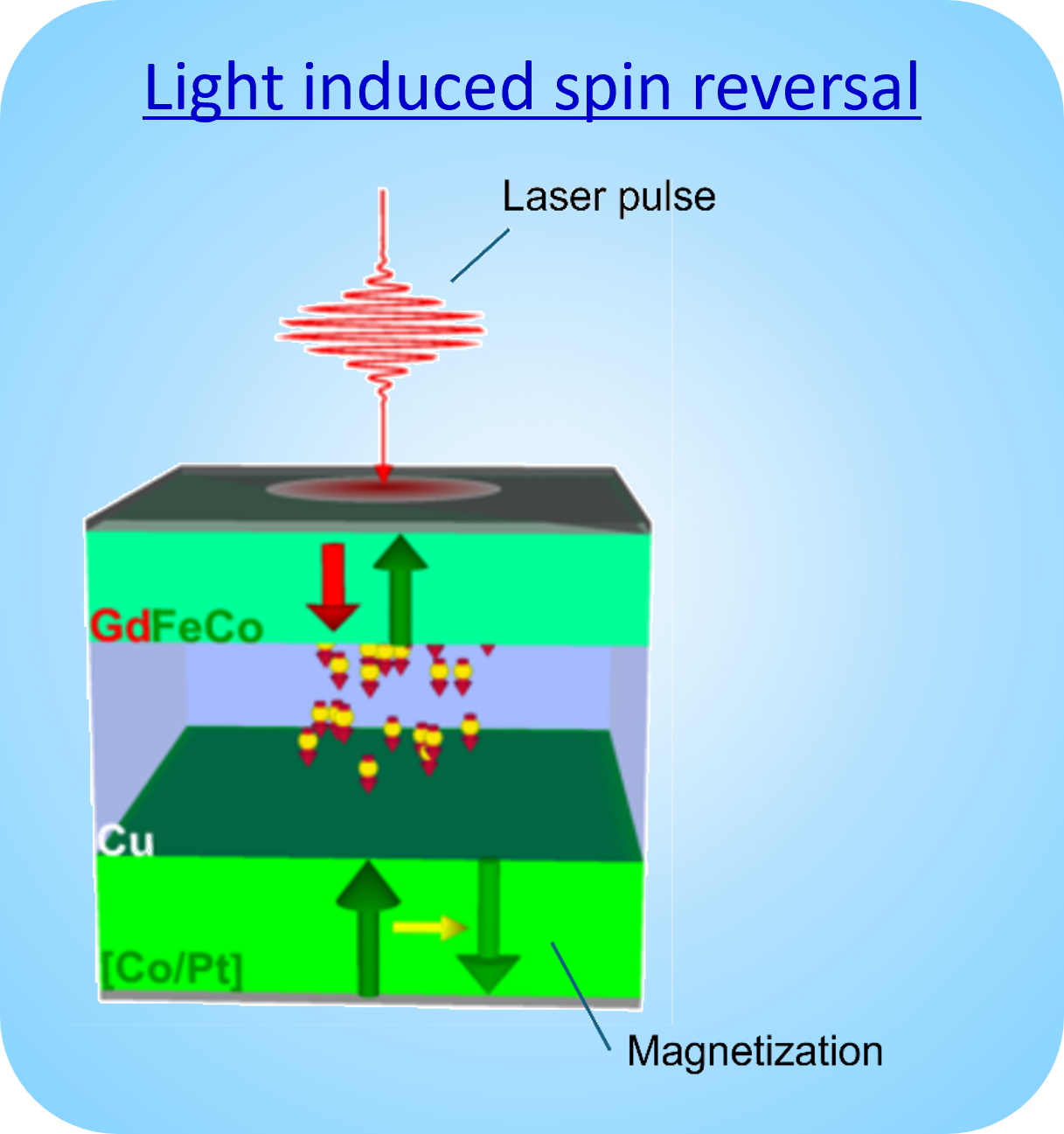 Light propagates at extremely high speeds with minimal loss and possesses many degrees of freedom, such as wavelength and polarization. Owing to these characteristics, light has long been utilized in communication technologies. In recent years, the active use of light for information processing has attracted significant attention as a promising route toward the realization of energy-efficient information-processing devices. The integration of photonics and spintronics, for example, has potential to be used for applications such as optical memories.
In addition to these aspects, by exploiting ultrashort optical pulses—an advanced photonic technology—it is also possible to probe ultrafast spin dynamics in magnetic thin films. To date, we have demonstrated magnetization reversal in ferromagnetic thin films using ultrashort optical pulses [1,2], realized magnetization control using the helicity of circularly polarized light [3,4], and measured high-speed magnetization dynamics in ferromagnetic thin films as well as in multilayered synthetic antiferromagnets [5,6]. More recently, we have been pursuing research aimed at enhancing the coupling between light and magnetic information in magnetic thin films, as well as developing novel magneto-optical measurement techniques based on photonic approaches.
Light propagates at extremely high speeds with minimal loss and possesses many degrees of freedom, such as wavelength and polarization. Owing to these characteristics, light has long been utilized in communication technologies. In recent years, the active use of light for information processing has attracted significant attention as a promising route toward the realization of energy-efficient information-processing devices. The integration of photonics and spintronics, for example, has potential to be used for applications such as optical memories.
In addition to these aspects, by exploiting ultrashort optical pulses—an advanced photonic technology—it is also possible to probe ultrafast spin dynamics in magnetic thin films. To date, we have demonstrated magnetization reversal in ferromagnetic thin films using ultrashort optical pulses [1,2], realized magnetization control using the helicity of circularly polarized light [3,4], and measured high-speed magnetization dynamics in ferromagnetic thin films as well as in multilayered synthetic antiferromagnets [5,6]. More recently, we have been pursuing research aimed at enhancing the coupling between light and magnetic information in magnetic thin films, as well as developing novel magneto-optical measurement techniques based on photonic approaches.
[1] S. Iihama et al., Adv. Mater. 30, 1804004 (2018). [2] K. Ishibashi, S. Iihama et al., Phys. Rev. Lett. 135, 116702 (2025). [3] S. Iihama et al., Nanophotonics 10, 1169 (2021). [4] K. Nukui, S. Iihama et al., Phys. Rev. Lett. 134, 016701 (2025). [5] S. Iihama et al., Phys. Rev. B 89, 174416 (2014). [6] A. Kamimaki, S. Iihama et al., Phys. Rev. Appl. 13, 044036 (2020).
AI spintronics
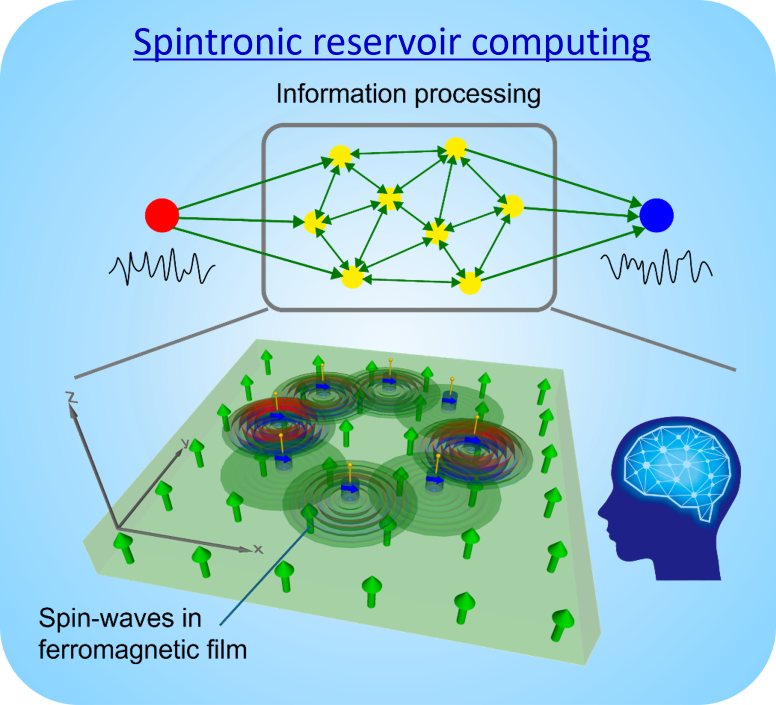 In recent years, artificial intelligence has great capabilities in many tasks and has been widely used across various fields; however, its enormous power consumption has simultaneously emerged as a serious issue. This problem originates from the fact that neural-network–based information processing is currently implemented based on conventional computing architectures. Consequently, intensive research has recently been devoted to the physical implementation of neural networks.
One such approach is physical reservoir computing. In physical reservoir computing, arbitrary natural physical dynamics are used as a neural network, enabling information processing that exploits intrinsic physical phenomena. By utilizing spintronic technologies, the realization of nanoscale, low-power, and high-performance physical reservoir computing is expected [1]. We are trying to evaluate performance of physical reservoir computing and perform experimental verification of physical reservoir computing.
In recent years, artificial intelligence has great capabilities in many tasks and has been widely used across various fields; however, its enormous power consumption has simultaneously emerged as a serious issue. This problem originates from the fact that neural-network–based information processing is currently implemented based on conventional computing architectures. Consequently, intensive research has recently been devoted to the physical implementation of neural networks.
One such approach is physical reservoir computing. In physical reservoir computing, arbitrary natural physical dynamics are used as a neural network, enabling information processing that exploits intrinsic physical phenomena. By utilizing spintronic technologies, the realization of nanoscale, low-power, and high-performance physical reservoir computing is expected [1]. We are trying to evaluate performance of physical reservoir computing and perform experimental verification of physical reservoir computing.
[1] S. Iihama et al., npj Spintronics 2, 5 (2024).
Magnonics: long distance spin transport
 Magnonics is an emerging field of magnetism that encompasses the investigation and control of spin wave excitations (magnons), which is a collective excitation of spin dynamics, as carriers of spin information in nano-structures[1]. In general, spin information diffuses and decays as it travels. Therefore, it is important to have materials with low spin current dissipation (or low magnetic damping). We have recently found that a long distance spin transport in antiferromagnetic NiO which is associated with propagating magnons [2-4].
[1] T. Moriyama et al., J. Phys. Condens. Matter 33, 413001 (2021). [2] T. Moriyama et al., Appl. Phys. Lett. 106, 162406 (2015). [3] S. Takei, T. Moriyamm et al.,Phys. Rev. B 92, 020409R (2015). [4] T. Ikebuchi, T. Moriyama et al., Appl. Phys. Exp. 11, 073003 (2018) and Appl. Phys. Exp. 14, 123001 (2021).
Spin-orbitronics
